
Ipamorelin is a synthetic pentapeptide that activates the growth hormone secretagogue receptor 1a, more commonly known as the ghrelin receptor. Its sequence — Aib-His-D-2-Nal-D-Phe-Lys-NH2 — is short, includes two D-amino acids and one non-proteinogenic residue, and ends in a C-terminal amide. These features give it far greater stability than a natural pentapeptide would have, which explains why it remains a reliable tool compound in growth-hormone axis research more than two decades after it was first described.
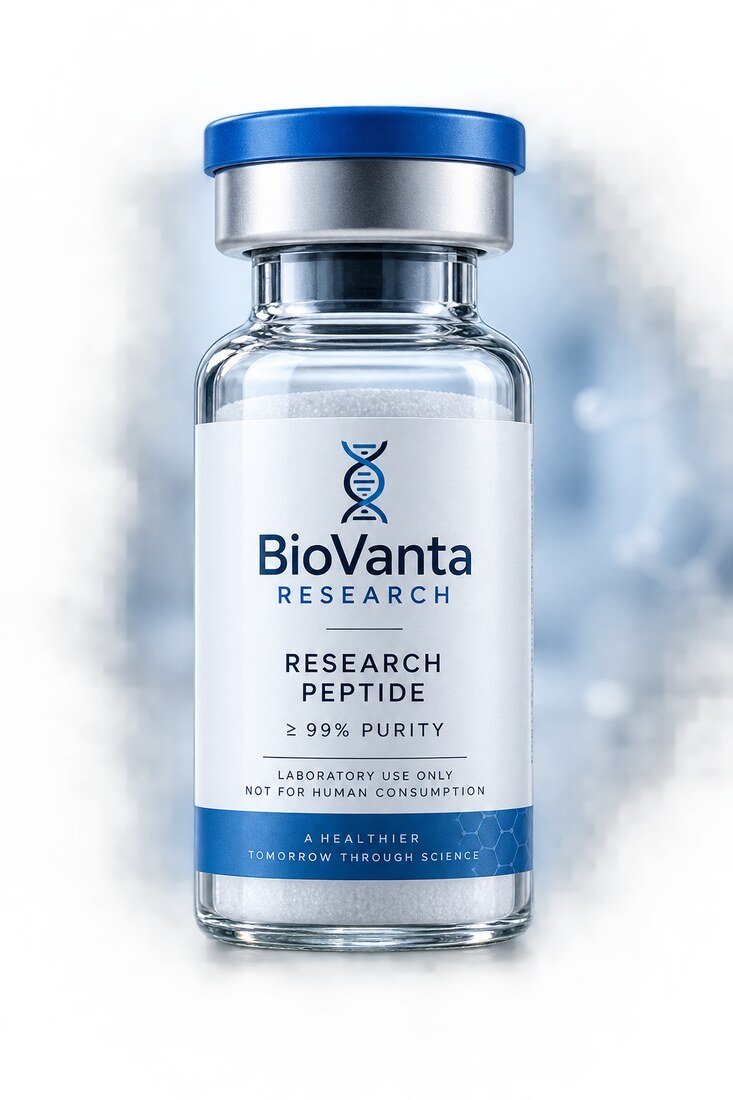
This listing supplies 5 mg of lyophilised ipamorelin at 96.4% HPLC purity with LC–MS identity confirmation, shipped cold-chain from Dublin with a lot-specific certificate of analysis.
Selectivity is the main selling point
Growth hormone secretagogues as a class tend to spill over onto other pituitary and adrenal pathways, lifting cortisol and prolactin along with growth hormone. That cross-reactivity is a problem for any experiment trying to isolate the growth-hormone axis specifically, since the observed effect becomes a blend of several endocrine changes and cause-and-effect becomes hard to pin down.
Ipamorelin was characterised specifically for its comparatively narrow activity profile — a secretagogue that engages GHS-R1a with minimal effect on ACTH and prolactin output in the models it was tested in. That selectivity is why it has stayed in use as a reference agonist rather than being replaced by more potent but less specific alternatives. When a study needs a GHS-R1a stimulus whose downstream effect can be attributed cleanly to one receptor, ipamorelin is usually the compound chosen.
The structural features behind this are worth noting for anyone characterising the material. The D-2-naphthylalanine and D-phenylalanine residues resist breakdown by proteases and hold a particular side-chain arrangement in place; the Aib residue at the N-terminus restricts backbone flexibility; and the C-terminal amide removes the terminal negative charge. All three show up in the mass spectrum, and the C-terminal amide especially should be confirmed rather than assumed, since the free-acid impurity differs by only one dalton.
What researchers use it to study
Most published work sits within endocrine pharmacology: GHS-R1a binding and functional assays measuring inositol phosphate accumulation or calcium mobilisation, and pituitary cell or perfused-pituitary preparations measuring growth hormone release alongside cortisol and prolactin to quantify selectivity. Ipamorelin often serves as the selective reference compound in these comparisons.
Outside the pituitary, GHS-R1a is also found in the gastrointestinal tract, and a body of work looks at gastric motility in rodent models. Further studies examine receptor expression in the central nervous system in relation to appetite and energy-balance signalling, and at bone and connective-tissue models where growth-hormone axis activity is the variable under study.
All of this is preclinical laboratory science. Ipamorelin has no medicinal authorisation in Ireland or the EU and is supplied here for in-vitro research and analytical reference use only, not for administration to people or animals.
Working with ipamorelin at the bench
Ipamorelin is one of the more straightforward peptides to handle. It dissolves readily in bacteriostatic or sterile water; 5 mg reconstituted in 2 mL gives a 2.5 mg/mL stock, roughly 3.5 mM, convenient for serial dilution down into the nanomolar range typical of GHS-R1a functional assays. Solutions remain stable at 2–8 °C for the window stated on the certificate, and the D-amino acid content makes it noticeably more resistant to trace protease activity in serum-containing media than a comparable all-L sequence would be.
The main practical concern is light and oxidation. The histidine and naphthylalanine residues are prone to photo-oxidation, so store solutions in amber vials or wrap them, and avoid leaving reconstituted stock exposed to lab lighting for long stretches. The oxidised form shows up in the mass spectrum at +16 daltons and elutes slightly earlier on a reverse-phase gradient, making it easy to spot if the method is set up to look for it.
For chromatography, a standard C18 gradient with 0.1% trifluoroacetic acid resolves the peptide cleanly. The naphthylalanine residue gives strong absorbance in the 260–280 nm region, a useful secondary detection channel alongside the 214 nm trace that helps distinguish peptide peaks from non-peptide artefacts.
- 5 mg + 2 mL bacteriostatic water = 2.5 mg/mL (~3.5 mM)
- Protect solutions from light; watch for the +16 Da oxidised form
- Confirm the C-terminal amide by mass (1 Da from the free acid)
- Strong 260–280 nm absorbance from the naphthylalanine residue
Storage, reconstitution and bench handling
A lyophilised vial arrives sealed under vacuum. If it isn’t going to be reconstituted within a few days, put it in a −20 °C freezer as soon as it’s unpacked. In powder form the peptide copes reasonably well with transit: the 2–8 °C gel-pack chain used for An Post and DPD delivery within Ireland, plus a short spell at room temperature while you unpack, won’t do it meaningful harm. What does harm it is moisture. Let the vial warm to room temperature before you crack the seal, or airborne water will settle on the cold glass and the cake, and slow hydrolysis starts from that moment.
Reconstitute using bacteriostatic water for injection, or plain sterile water if the solution will be used the same day. Run the diluent gently down the inside of the vial rather than firing it straight at the cake — a fine mist thrown up by a hard stream is peptide lost to the walls. Swirl the vial by hand, or simply let it stand for ten to fifteen minutes and allow the powder to go into solution unassisted. Do not vortex or shake it: shear forces at the surface of the liquid unfold peptide chains, and this is the single most frequent reason a solution that assays fine still performs erratically at the bench.
Once dissolved, keep the vial at 2–8 °C out of the light and use it within the window given on that lot’s certificate of analysis. For anything longer, split the stock into single-use volumes in low-binding polypropylene tubes and freeze at −20 °C or colder. Thawing and refreezing repeatedly works against you: every cycle concentrates dissolved material at the advancing ice edge and pushes the peptide toward aggregation, so material drawn from the same vial the twentieth time is not really the same as material drawn the first time.
- Lyophilised: −20 °C, kept dry and dark
- Reconstituted: 2–8 °C, single-use aliquots recommended
- Warm to room temperature before opening to stop condensation forming
- Swirl by hand — never vortex or shake
- Label each aliquot with the lot number and the reconstitution date
Reading this lot’s certificate of analysis
96.4% at 214 nm is a typical figure for a peptide containing D-amino acids and a non-proteinogenic residue, where coupling efficiency at the more hindered positions runs lower than for a standard sequence. The certificate itemises related substances above the reporting threshold, which for this sequence are usually the free-acid form, the oxidised species, and diastereomeric impurities from partial racemisation.
Diastereomers matter more here than for most catalogue peptides. A D-to-L inversion at either D-residue produces a molecule of identical mass, which mass spectrometry alone won’t distinguish — only chromatographic separation catches it. If stereochemical integrity matters to your work, check the chromatogram rather than the mass confirmation alone, and note whether the method actually resolves those peaks.
Paperwork, compliance and shipping from Ireland
Every box leaving our Dublin site comes with a certificate of analysis tied to that specific lot. It records the HPLC assay result together with the method used to obtain it, identity confirmation by LC–MS against a reference standard, residual solvent levels, Karl Fischer water content, and endotoxin limits. Any purity figure quoted without the method behind it tells you very little, and it’s usually the first thing a knowledgeable buyer wants to see when weighing up suppliers. Certificates are kept on file by lot, so a reorder can always be checked against the data generated for the original batch.
Orders are priced in euro, dispatched from Dublin under a recorded 2–8 °C cold chain, and reach addresses within Ireland the next working day via An Post or DPD. Northern Ireland and the rest of the EU take two to three days. Because shipments stay within a domestic network, there’s no customs clearance, no surprise import VAT, and no multi-day hold at a border post — which does more for peptide integrity than any figure printed on the box.
This material is intended solely for in-vitro laboratory research and analytical reference purposes. It is not a medicine, not a food supplement, and it is not cleared for use in humans or animals. Buyers are responsible for handling, containing and disposing of it in line with their institution’s rules and with Irish and EU law.
Frequently asked questions
- Why is ipamorelin described as selective?
- In the models where it has been studied, it activates the GHS-R1a receptor with comparatively little effect on ACTH and prolactin output, allowing researchers to attribute downstream effects to one receptor rather than a mix of endocrine changes.
- How should ipamorelin solutions be stored?
- At 2–8 °C, shielded from light in amber or wrapped vials, ideally split into single-use aliquots. The histidine and naphthylalanine residues are prone to photo-oxidation, seen as a +16 Da species by mass.
- What purity does this lot carry?
- 96.4% by reverse-phase HPLC at 214 nm with LC–MS identity confirmation, itemised related substances, and a full lot-specific certificate of analysis in the box.
- Is ipamorelin legal to buy in Ireland?
- It can be supplied for laboratory research and analytical reference use. It is not authorised as a medicine in Ireland or the EU and must not be used for human or veterinary administration.
For laboratory research use only. Not for human or veterinary use, not a medicinal product, not a food supplement.
Reviews
There are no reviews yet.