
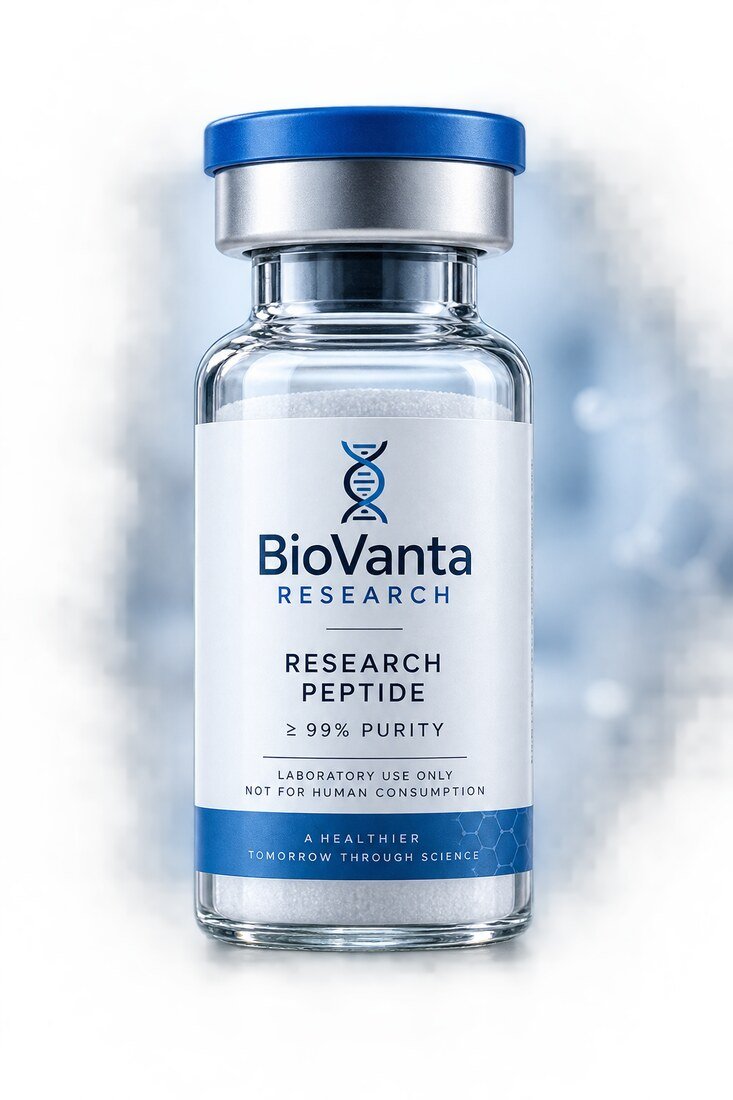
BioVanta Research supplies BPC-157 & TB-500 Blend in 2 sizes (10 mg, 20 mg), dispatched under cold chain from our Dublin facility with a lot-specific certificate of analysis included in every box. This blend combines BPC-157 and TB-500 at a fixed ratio in one lyophilised vial, letting an angiogenesis and cytoskeletal-repair experiment proceed from a single reconstitution rather than mixing two separate stocks by hand.
Each component is assayed individually before blending, and the certificate of analysis lists both alongside the combined fill weight. Prices are in euro, delivery within Ireland is tracked via An Post or DPD, and the material is supplied strictly for laboratory research use.
What BPC-157 & TB-500 Blend is
This blend combines BPC-157 and TB-500 at a fixed ratio in one lyophilised vial, letting an angiogenesis and cytoskeletal-repair experiment proceed from a single reconstitution rather than mixing two separate stocks by hand.
Each component is assayed individually before blending, and the certificate of analysis lists both alongside the combined fill weight.
What the research examines
The combination suits investigators studying tissue-repair models where both angiogenic signalling and actin-mediated cell migration are of interest, rather than isolating one pathway at a time.
Tendon, ligament and soft-tissue repair models are the most common settings reported for this pairing.
How BPC-157 & TB-500 Blend is handled at the bench
Reconstitute with the full recommended volume to keep the ratio between the two peptides intact; partial reconstitution changes their relative concentrations.
Handle as for the individual peptides — reconstitute gently, avoid vortexing, and keep aliquots cold or frozen between uses.
Sizes, pricing and what’s in the box
BPC-157 & TB-500 Blend is available in 10 mg, 20 mg. Every vial is filled and sealed to the same specification, so choosing a larger size gets you the same material at a lower cost per milligram rather than a different grade. For studies running over several months, a larger fill also cuts down the number of separate lots you need to track and reconcile against your data.
Every order comes with the lot’s certificate of analysis, giving the assay figure and the method behind it, identity confirmation, and the release date. Certificates are kept on file by lot, so a repeat order can always be checked against the batch that generated your original data.
- 10 mg — €39.90
- 20 mg — €49.90
Storage, reconstitution and bench handling
A lyophilised vial arrives sealed under vacuum. If it isn’t going to be reconstituted within a few days, put it in a −20 °C freezer as soon as it’s unpacked. In powder form the peptide copes reasonably well with transit: the 2–8 °C gel-pack chain used for An Post and DPD delivery within Ireland, plus a short spell at room temperature while you unpack, won’t do it meaningful harm. What does harm it is moisture. Let the vial warm to room temperature before you crack the seal, or airborne water will settle on the cold glass and the cake, and slow hydrolysis starts from that moment.
Reconstitute using bacteriostatic water for injection, or plain sterile water if the solution will be used the same day. Run the diluent gently down the inside of the vial rather than firing it straight at the cake — a fine mist thrown up by a hard stream is peptide lost to the walls. Swirl the vial by hand, or simply let it stand for ten to fifteen minutes and allow the powder to go into solution unassisted. Do not vortex or shake it: shear forces at the surface of the liquid unfold peptide chains, and this is the single most frequent reason a solution that assays fine still performs erratically at the bench.
Once dissolved, keep the vial at 2–8 °C out of the light and use it within the window given on that lot’s certificate of analysis. For anything longer, split the stock into single-use volumes in low-binding polypropylene tubes and freeze at −20 °C or colder. Thawing and refreezing repeatedly works against you: every cycle concentrates dissolved material at the advancing ice edge and pushes the peptide toward aggregation, so material drawn from the same vial the twentieth time is not really the same as material drawn the first time.
- Lyophilised: −20 °C, kept dry and dark
- Reconstituted: 2–8 °C, single-use aliquots recommended
- Warm to room temperature before opening to stop condensation forming
- Swirl by hand — never vortex or shake
- Label each aliquot with the lot number and the reconstitution date
Paperwork, compliance and shipping from Ireland
Every box leaving our Dublin site comes with a certificate of analysis tied to that specific lot. It records the HPLC assay result together with the method used to obtain it, identity confirmation by LC–MS against a reference standard, residual solvent levels, Karl Fischer water content, and endotoxin limits. Any purity figure quoted without the method behind it tells you very little, and it’s usually the first thing a knowledgeable buyer wants to see when weighing up suppliers. Certificates are kept on file by lot, so a reorder can always be checked against the data generated for the original batch.
Orders are priced in euro, dispatched from Dublin under a recorded 2–8 °C cold chain, and reach addresses within Ireland the next working day via An Post or DPD. Northern Ireland and the rest of the EU take two to three days. Because shipments stay within a domestic network, there’s no customs clearance, no surprise import VAT, and no multi-day hold at a border post — which does more for peptide integrity than any figure printed on the box.
This material is intended solely for in-vitro laboratory research and analytical reference purposes. It is not a medicine, not a food supplement, and it is not cleared for use in humans or animals. Buyers are responsible for handling, containing and disposing of it in line with their institution’s rules and with Irish and EU law.
Frequently asked questions
- What sizes of BPC-157 & TB-500 Blend are available?
- 10 mg, 20 mg. All sizes are drawn from the same production run and carry the same assay specification; only the fill quantity changes.
- What purity does this lot of BPC-157 & TB-500 Blend carry?
- 97.6%, with the analytical method and conditions set out on the lot-specific certificate of analysis supplied in the box.
- How should BPC-157 & TB-500 Blend be stored?
- Lyophilised material at −20 °C, kept dry and dark. Once reconstituted, at 2–8 °C in single-use aliquots.
- How quickly does BPC-157 & TB-500 Blend ship within Ireland?
- Orders placed before the daily cut-off leave Dublin the same working day and arrive on a tracked An Post or DPD service within Ireland, with a two- to three-day service to Northern Ireland and the rest of the EU.
- Is BPC-157 & TB-500 Blend legal to buy in Ireland?
- It can be supplied for laboratory research and analytical reference use. It is not a medicinal product, not a food supplement, and it is not authorised for human or veterinary administration in Ireland or the EU.
For laboratory research use only. Not for human or veterinary use, not a medicinal product, not a food supplement.
Reviews
There are no reviews yet.