
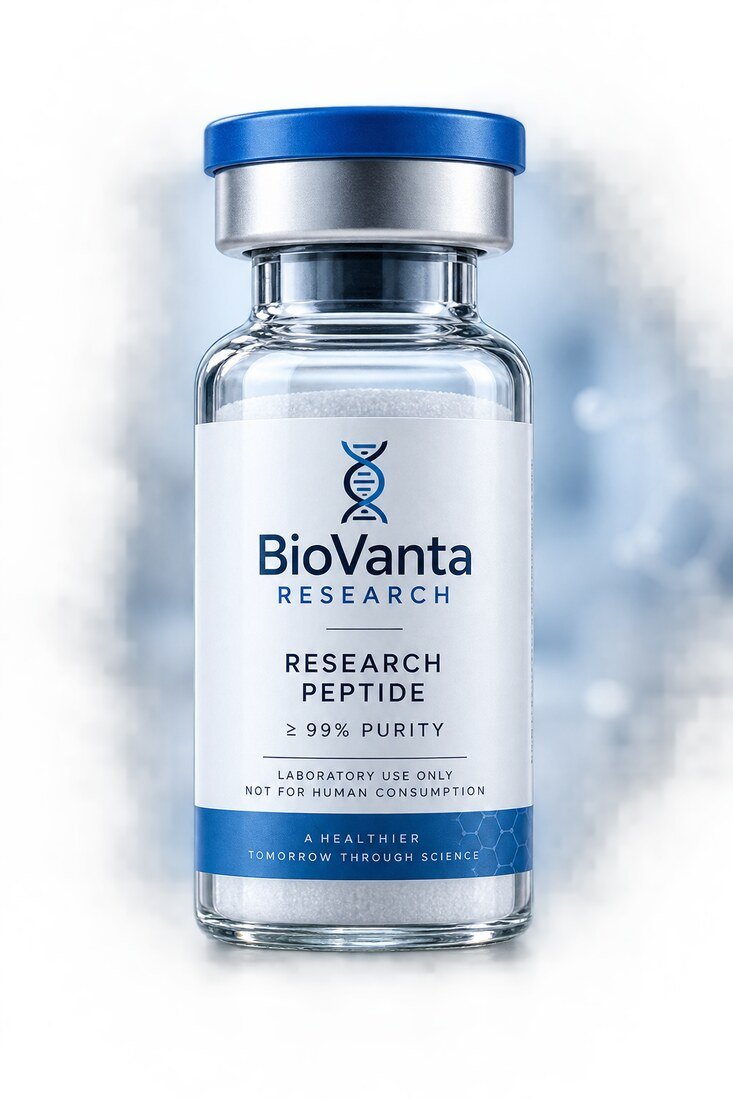
BPC-157 is a synthetic fifteen-amino-acid peptide matching part of the sequence of body protection compound, a protein first isolated from human gastric juice. It has become a regular fixture in regenerative-research laboratories because it holds up well in aqueous solution, characterises cleanly by HPLC, and behaves consistently across a broad pH range — qualities that make it as useful as a control article as it is a subject of study in its own right.
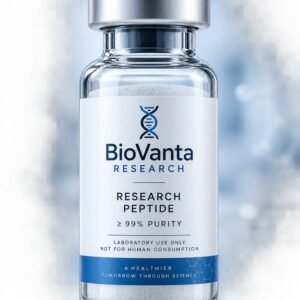
This listing covers 5 mg of lyophilised BPC-157 acetate, assayed at 98.2% by reverse-phase HPLC and identity-confirmed by LC–MS against a reference standard. Each vial is accompanied by a certificate of analysis specific to its lot and ships under cold chain from Dublin.
The parent protein and where BPC-157 fits
Body protection compound is a substantial protein found in gastric juice, thought to contribute to the stomach lining’s ability to withstand conditions that would destroy most other tissue within hours. BPC-157 is the fifteen-residue segment of that protein retained for laboratory use because it reproduces much of the parent’s activity in experimental models while being short enough to make reliably by solid-phase synthesis. Its sequence — Gly-Glu-Pro-Pro-Pro-Gly-Lys-Pro-Ala-Asp-Asp-Ala-Gly-Leu-Val — includes a proline-dense stretch that locks the backbone into a rigid, compact shape and helps it resist enzymatic breakdown.
That resistance to degradation is a large part of why BPC-157 appears so often in published studies. Many short peptides fall apart within minutes in biological buffers, which frustrates any attempt at clean dose–response work; BPC-157 stays intact long enough to support proper time-course experiments. It is supplied here as the acetate salt, standard practice for research peptides, meaning the assay figure describes the free-base peptide content while the counter-ion adds to the total weight in the vial.
What researchers use it to study
Published work on BPC-157 tends to cluster around a handful of subjects. The largest concerns tissue-repair models — tendon, ligament, muscle and gut lining — where researchers track fibroblast movement, collagen structure and healing speed. A second cluster looks at angiogenesis, especially the vascular endothelial growth factor pathway and endothelial tube formation in culture. A third examines gastrointestinal protection in NSAID-injury models, which follows naturally from the peptide’s origin in gastric tissue.
It’s worth being clear about the limits of this evidence. Nearly all of it comes from cell culture and rodent studies, and BPC-157 carries no marketing authorisation in Ireland, the EU, or anywhere else we’re aware of. Findings in these systems describe behaviour under defined experimental conditions — they don’t demonstrate an effect in people, and nothing here should be read to imply otherwise. What a high-purity reference lot gives a laboratory is the ability to reproduce and test published findings rather than introduce extra variability of its own.
Working with BPC-157 in the lab
For in-vitro work, BPC-157 is usually reconstituted to a stock of 1–2.5 mg/mL and diluted into medium across a range spanning several orders of magnitude, since its concentration–response behaviour is often non-linear and a narrow window can miss the response altogether. Many groups run a vehicle control matched for bacteriostatic water content, because benzyl alcohol at higher volumes isn’t inert in sensitive cell lines.
For a 5 mg vial, 2 mL of bacteriostatic water gives 2.5 mg/mL, a practical stock for serial dilution. Using 5 mL instead gives 1 mg/mL, which cuts down pipetting error at low concentrations but shortens the refrigerated life of each aliquot. Whatever the volume, note it on the label along with the lot number and date — poor record-keeping, not the peptide itself, is the most common cause of irreproducible results.
Analytical groups also reach for BPC-157 as a system-suitability standard for reverse-phase methods. Its proline-rich core gives a sharp, repeatable peak on a C18 column with a standard water/acetonitrile gradient and 0.1% trifluoroacetic acid, useful for checking column performance ahead of running less well-behaved compounds.
- Typical stock: 1–2.5 mg/mL in bacteriostatic water
- Include a vehicle-matched control in every plate
- Cover several log units when building a concentration curve
- Works well as a C18 system-suitability reference
Storage, reconstitution and bench handling
A lyophilised vial arrives sealed under vacuum. If it isn’t going to be reconstituted within a few days, put it in a −20 °C freezer as soon as it’s unpacked. In powder form the peptide copes reasonably well with transit: the 2–8 °C gel-pack chain used for An Post and DPD delivery within Ireland, plus a short spell at room temperature while you unpack, won’t do it meaningful harm. What does harm it is moisture. Let the vial warm to room temperature before you crack the seal, or airborne water will settle on the cold glass and the cake, and slow hydrolysis starts from that moment.
Reconstitute using bacteriostatic water for injection, or plain sterile water if the solution will be used the same day. Run the diluent gently down the inside of the vial rather than firing it straight at the cake — a fine mist thrown up by a hard stream is peptide lost to the walls. Swirl the vial by hand, or simply let it stand for ten to fifteen minutes and allow the powder to go into solution unassisted. Do not vortex or shake it: shear forces at the surface of the liquid unfold peptide chains, and this is the single most frequent reason a solution that assays fine still performs erratically at the bench.
Once dissolved, keep the vial at 2–8 °C out of the light and use it within the window given on that lot’s certificate of analysis. For anything longer, split the stock into single-use volumes in low-binding polypropylene tubes and freeze at −20 °C or colder. Thawing and refreezing repeatedly works against you: every cycle concentrates dissolved material at the advancing ice edge and pushes the peptide toward aggregation, so material drawn from the same vial the twentieth time is not really the same as material drawn the first time.
- Lyophilised: −20 °C, kept dry and dark
- Reconstituted: 2–8 °C, single-use aliquots recommended
- Warm to room temperature before opening to stop condensation forming
- Swirl by hand — never vortex or shake
- Label each aliquot with the lot number and the reconstitution date
Reading this lot’s certificate of analysis
The assay result reports purity as the proportion of total peak area measured at 214 nm, the wavelength at which the peptide backbone itself absorbs. A figure quoted at 220 nm or 280 nm is a different measurement and shouldn’t be compared directly — 280 nm in particular only picks up aromatic residues, which flatters sequences that contain few of them. Our certificates always state the wavelength, column, gradient and run time so the number can be checked independently.
LC–MS identity confirmation should match the expected monoisotopic mass of the target sequence, not just show a fragment that looks plausible. Karl Fischer water content matters because a cake that has drawn in a few percent moisture will overstate the peptide delivered if you weigh the powder rather than dissolving the whole vial. Residual solvent and endotoxin figures round out the picture for cell-based work, where a clean assay result alongside an unchecked endotoxin load produces results that look tidy but are not telling you what you think they are.
Paperwork, compliance and shipping from Ireland
Every box leaving our Dublin site comes with a certificate of analysis tied to that specific lot. It records the HPLC assay result together with the method used to obtain it, identity confirmation by LC–MS against a reference standard, residual solvent levels, Karl Fischer water content, and endotoxin limits. Any purity figure quoted without the method behind it tells you very little, and it’s usually the first thing a knowledgeable buyer wants to see when weighing up suppliers. Certificates are kept on file by lot, so a reorder can always be checked against the data generated for the original batch.
Orders are priced in euro, dispatched from Dublin under a recorded 2–8 °C cold chain, and reach addresses within Ireland the next working day via An Post or DPD. Northern Ireland and the rest of the EU take two to three days. Because shipments stay within a domestic network, there’s no customs clearance, no surprise import VAT, and no multi-day hold at a border post — which does more for peptide integrity than any figure printed on the box.
This material is intended solely for in-vitro laboratory research and analytical reference purposes. It is not a medicine, not a food supplement, and it is not cleared for use in humans or animals. Buyers are responsible for handling, containing and disposing of it in line with their institution’s rules and with Irish and EU law.
Frequently asked questions
- What purity is this BPC-157 lot?
- 98.2% by reverse-phase HPLC at 214 nm, with identity confirmed by LC–MS. The precise figure and the method used are stated on the lot-specific certificate of analysis in the box.
- How should BPC-157 be reconstituted?
- Add 2 mL of bacteriostatic water to the 5 mg vial for a 2.5 mg/mL stock, running the stream down the inside of the vial. Swirl gently — never vortex — and keep the reconstituted solution at 2–8 °C away from light.
- How long does delivery take within Ireland?
- Orders placed before the daily cut-off leave Dublin the same working day and arrive on a tracked An Post or DPD service, kept under a documented 2–8 °C cold chain with gel packs throughout.
- Is BPC-157 approved for human use?
- No. It has no medicinal authorisation in Ireland or the EU. It is supplied strictly for in-vitro laboratory research and analytical reference use, not for human or veterinary administration.
For laboratory research use only. Not for human or veterinary use, not a medicinal product, not a food supplement.
Reviews
There are no reviews yet.